Week 1- The Garden is Our Multisensorial Lab!
We started on Monday, May 18. This is the first collaboration between Vision.AI.R-E as an organisation and Proyecto Opciones. Some participants knew me, Ana Sánchez Colberg, the team leader, because I had done individual workshops with them in autumn 2025. Those workshops used the Yo Quiero Bailar topic of sound, movement and colour — handkerchiefs, bells, drawing — making multi-sensorial connections across modalities. The reason this approach matters for this population is that perception is not single-channel. Sound is aural, but it can be connected to colour; colour can be connected to both sound and movement. The tasks we design are interconnected across modalities from the start. This summer we take that further.
We are working in the sculpture garden of the Museum of Art of Puerto Rico, and that location was a specific methodological choice. The theme for this year is La Naturaleza y Yo — Nature and Me — and the garden is not background to that theme. It is the content.
The Morning Structure
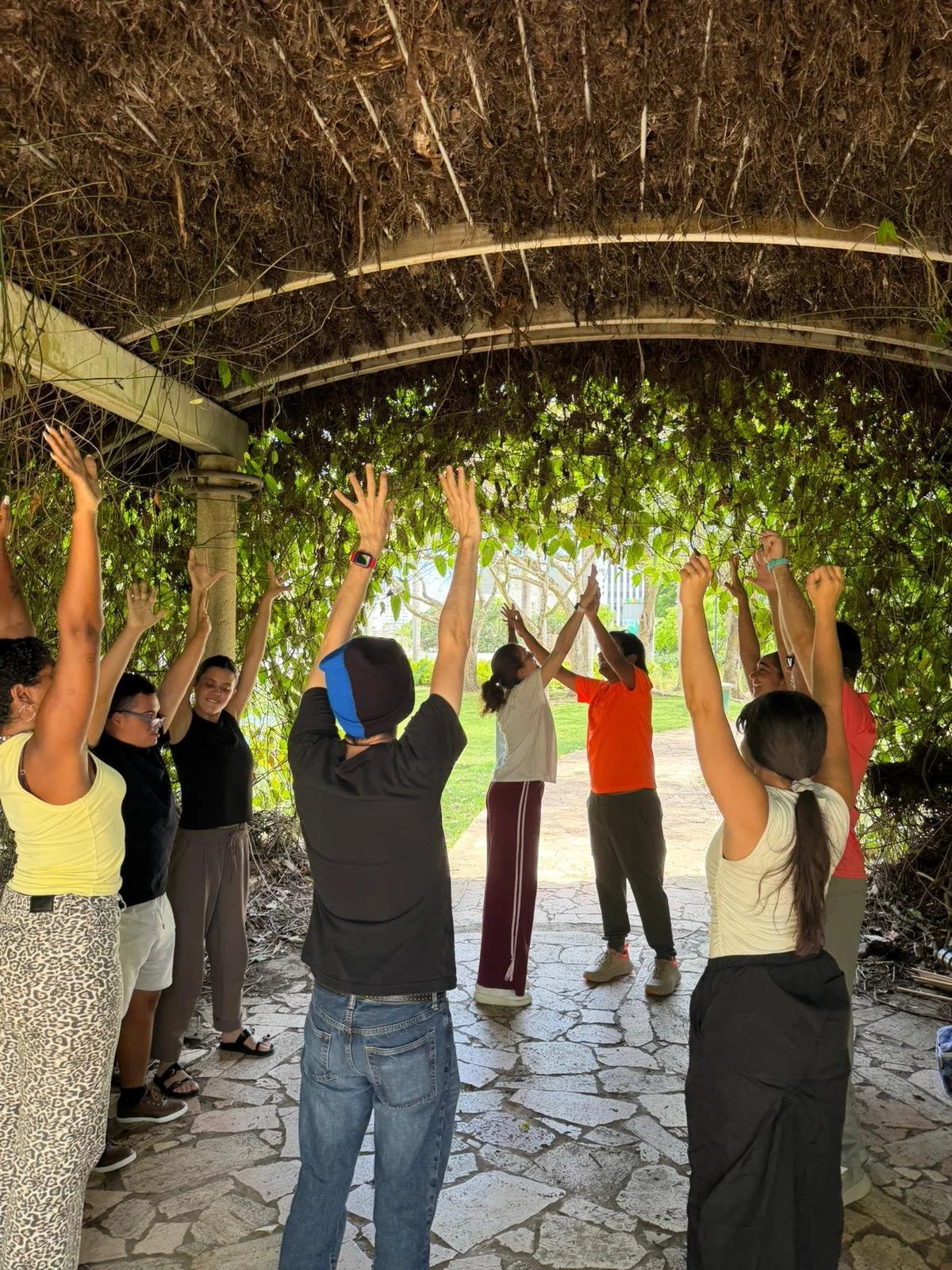
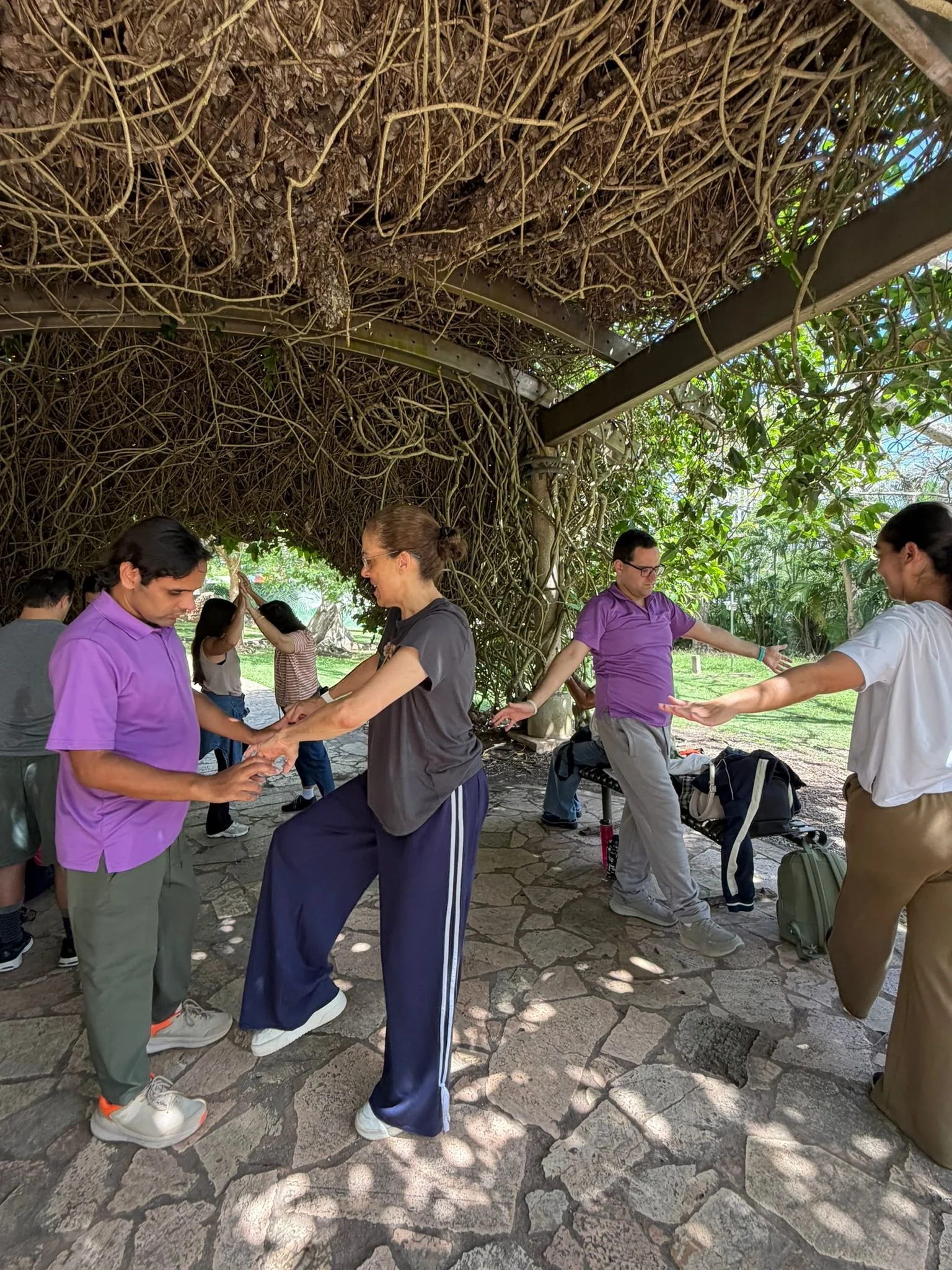
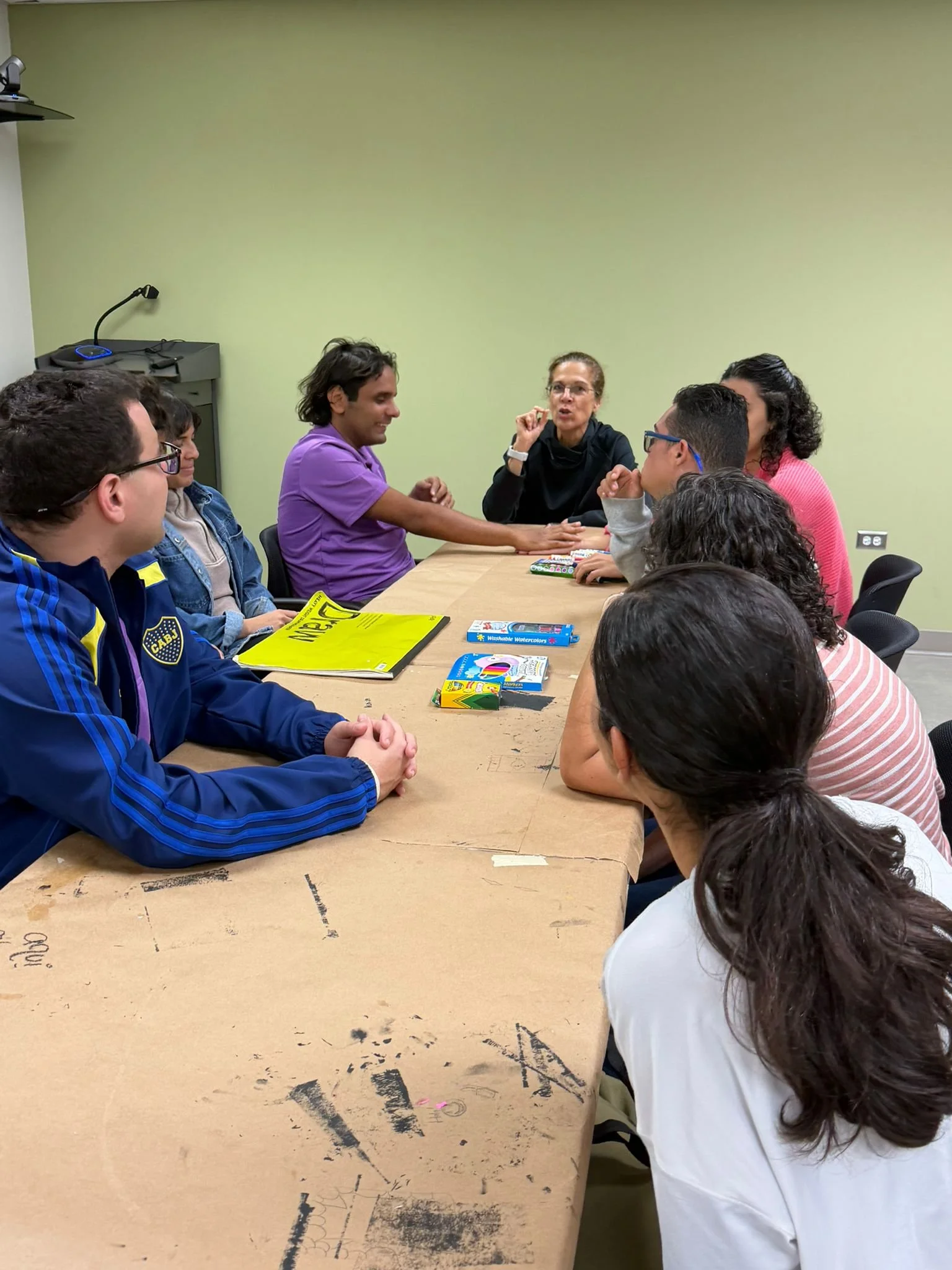
We have two hours every day, 9.30 to 11.30. The warm-up follows the same sequence every morning: slowly activating head, shoulders, back, core stability and cross-motor coordination, individually in a circle. Then we move into pair “mirror work” exercise. Working in pairs, each person holds the other’s attention and focus — one leads, one follows, then they switch. It is a simple structure that makes sustained attention to another person the task itself.
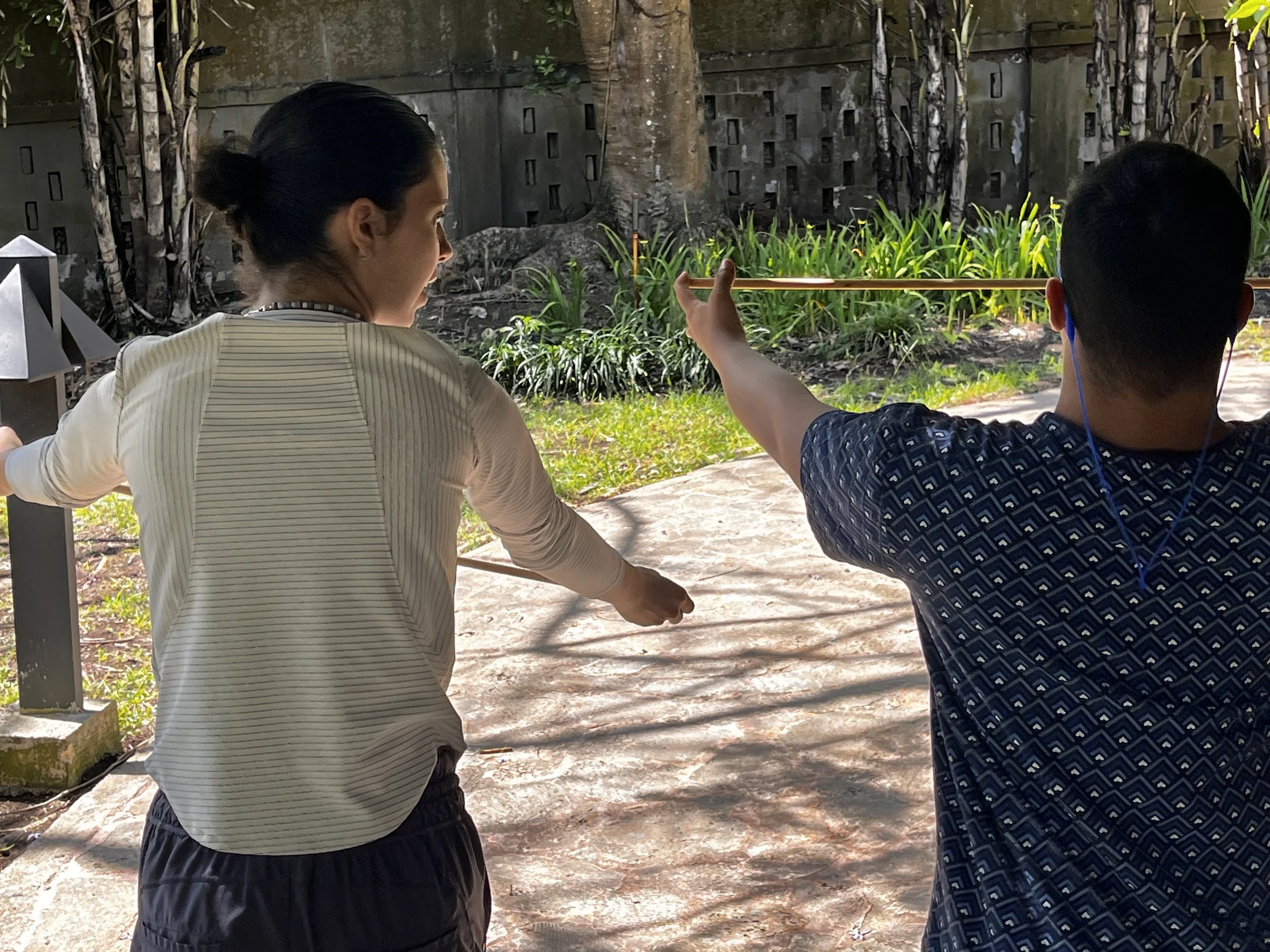
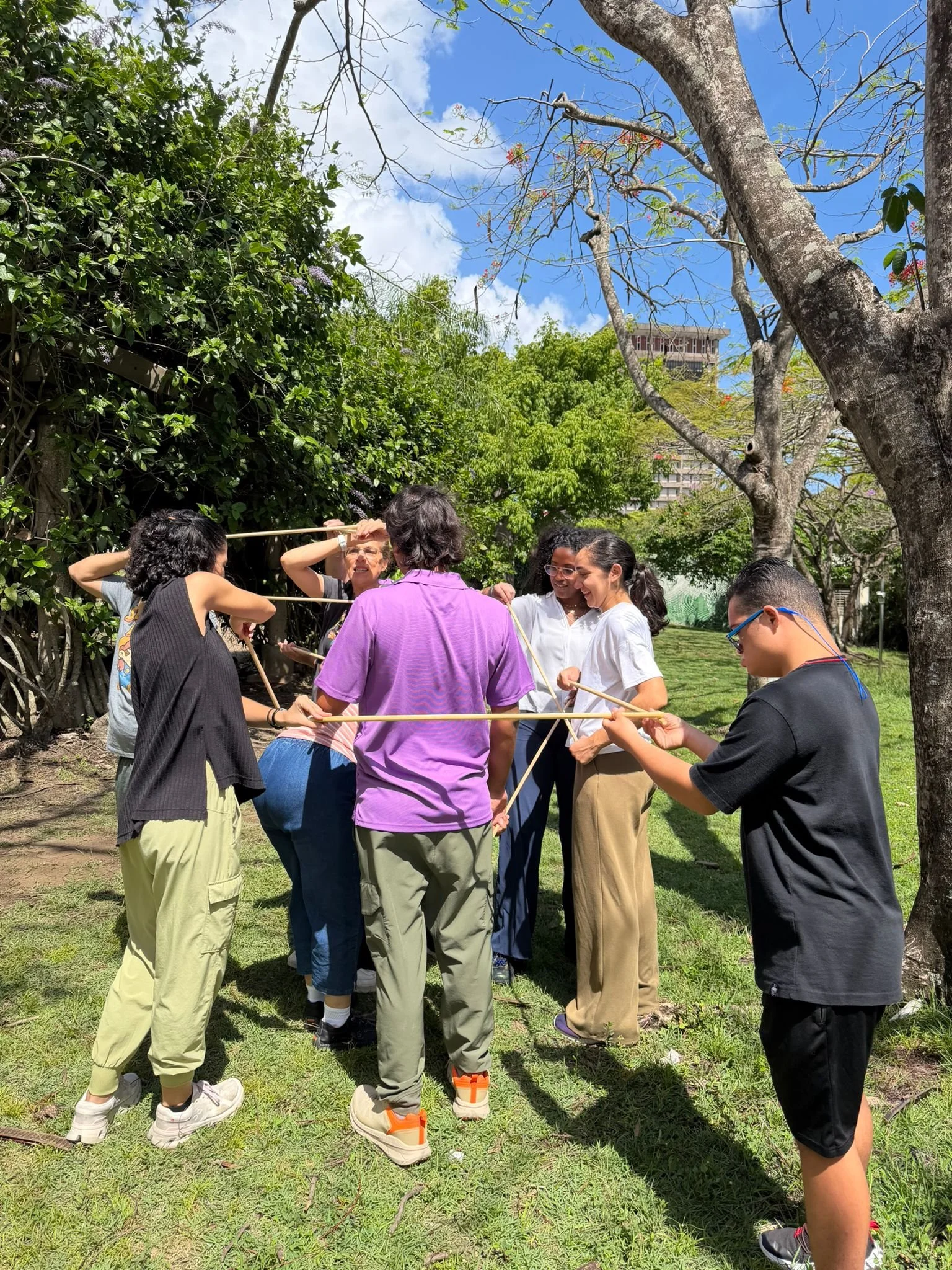
From the mirror we move into the exercise every group we have ever worked with has loved: the palitos, the bamboo sticks. This exercise draws on the Lecoq–Meyerhold tradition of using bamboo sticks for rhythm and coordination, adapted specifically for this population. It unfolds in three layers. The first layer: each participant holds the stick at both ends — fine grip is already being worked — and the task is to take the stick for a walk. By holding both ends they can twist, work the biceps up and down, engage the obliques left and right, stretch the quads by lowering the stick, and row forward and back through the full extension and contraction of the arm system. It looks like play. Behind it is kinesiology — when you train as a dancer, kinesiology is part of the training. Paul Klee, writing at the Bauhaus in 1925, described his pedagogical drawing practice as “taking a line for a walk” — the resonance with the palito task is not accidental. In both cases, an object becomes an instrument of perception rather than a subject of it. The second layer works in pairs. The stick is held between two participants who must walk together, negotiating who guides and who follows through the soft push of the stick between them. Each partner reads the other’s intention through a shared tool — this is the proprioceptive equivalent of what Daniel Stern (1985) called affect attunement: the cross-modal matching of dynamic contours between two people. And you cannot drop the stick. In this group, participants are allowed to hold it rather than just touching it at the centre of the palm — that is the original Lecoq exercise — but a step at a time.The third layer is an innovation of this methodology and does not exist in Lecoq or Meyerhold. The whole group stands in a circle with one stick between each participant, held at both ends. We call it the knot — el nudo. The task borrows from the Puerto Rican children’s game pasemisín-pasemison, holding all the sticks together, the group creates bridges to pass through, or lowers them to make steps to cross. Everything happens simultaneously. At some point the centripetal motion produces a real knot — nobody can move anywhere. Everyone is laughing. The task then is to unknot the group without dropping a single stick. This is collective proprioception: the group becomes a single distributed body schema. Every group we have ever worked with has loved this exercise. This group was no different.
After the warm-up, a short water break, and then the four sub-teams — each facilitator with one to three participants — walk through the section of the garden that has sculptures, mature trees, plants and water features. We are memory guides and imagination guides. Even on the walk from the museum gate to the meeting point, sub-teams highlight things in nature and invite observation, because on some mornings it rained and the longer walk had to be cut short. Nothing is wasted. After the break, more or less the first hour has passed, and the afternoon tasks begin.
Day 1, Monday May 18 — The Self-Portrait
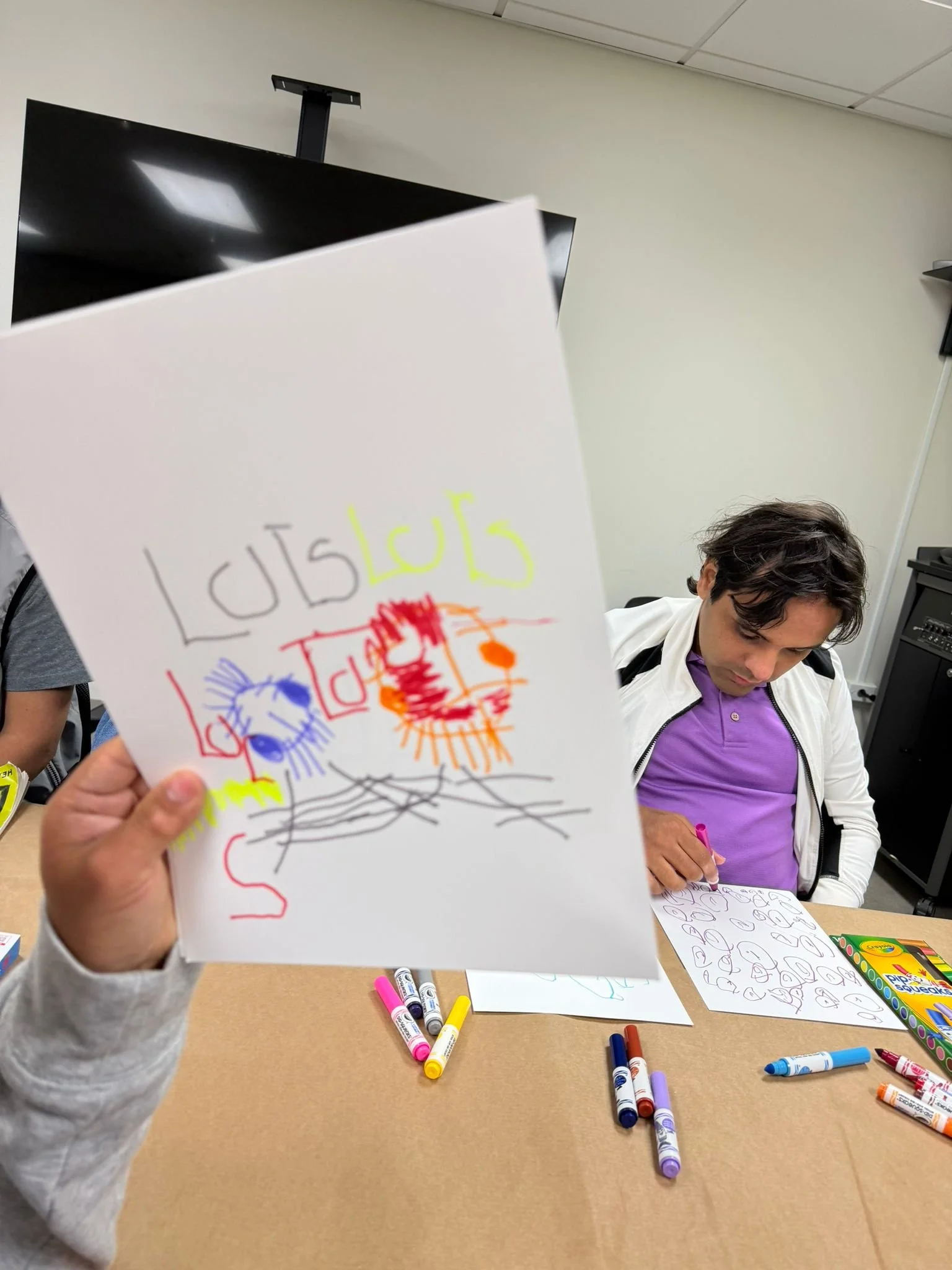
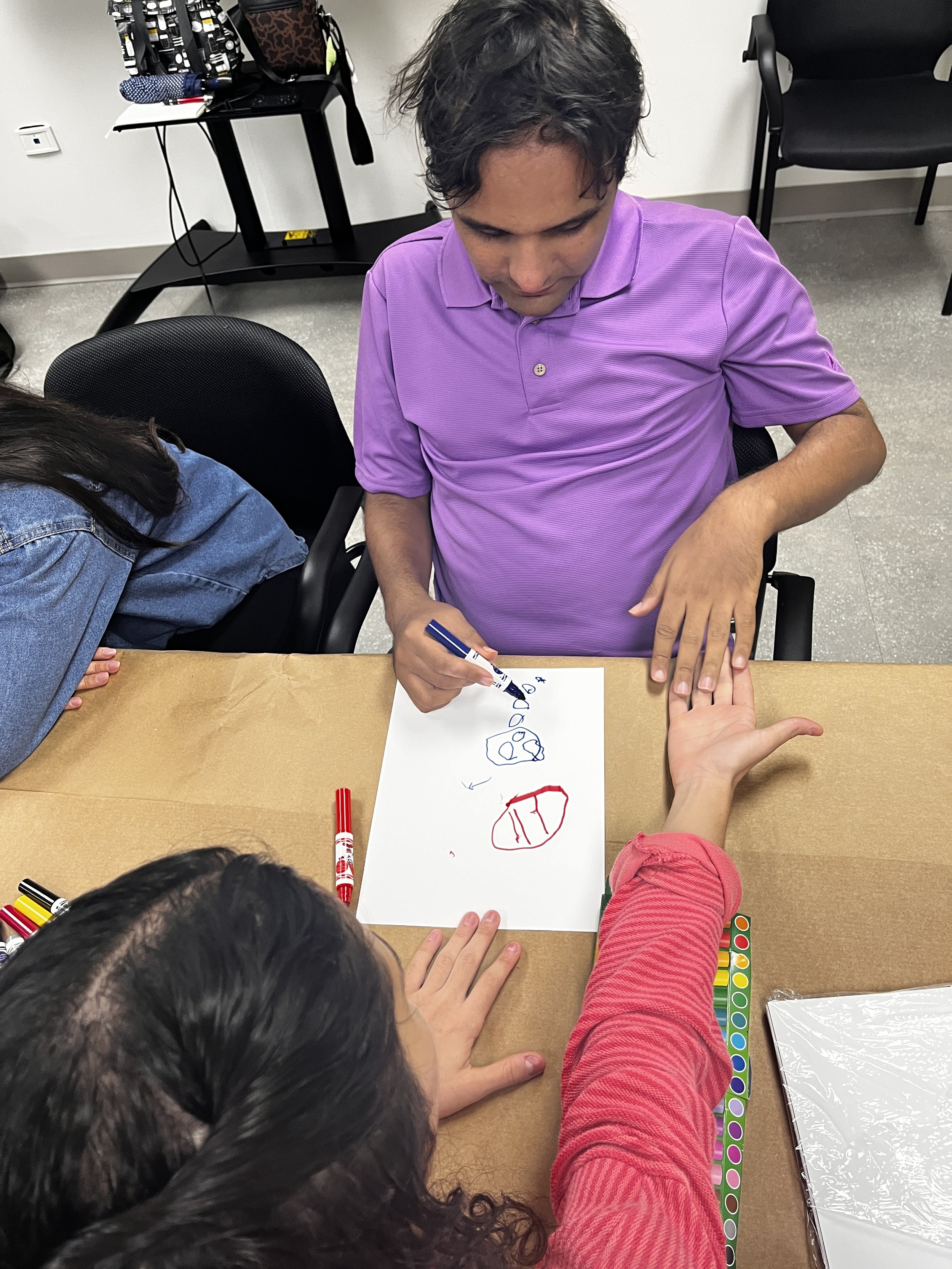
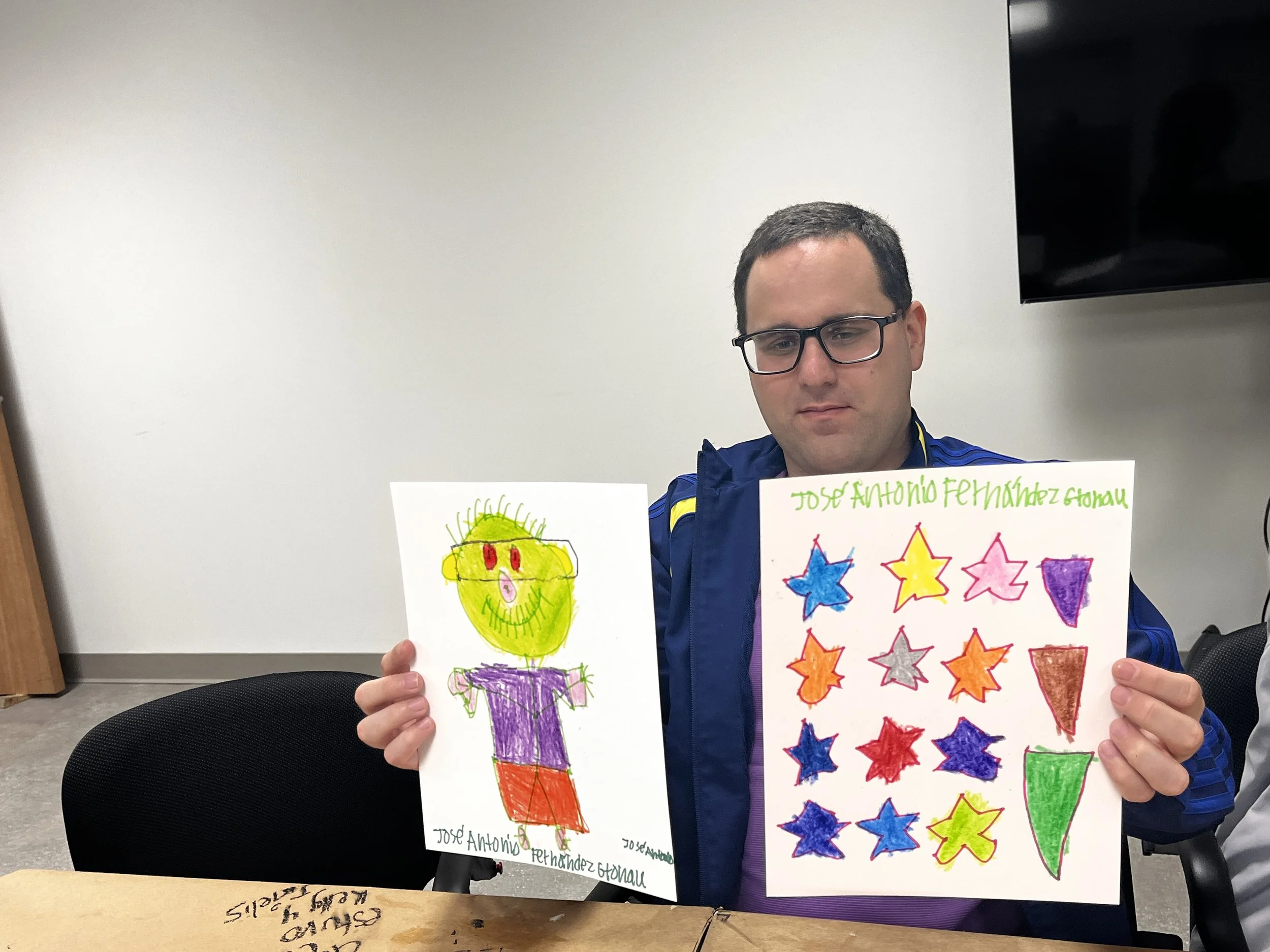
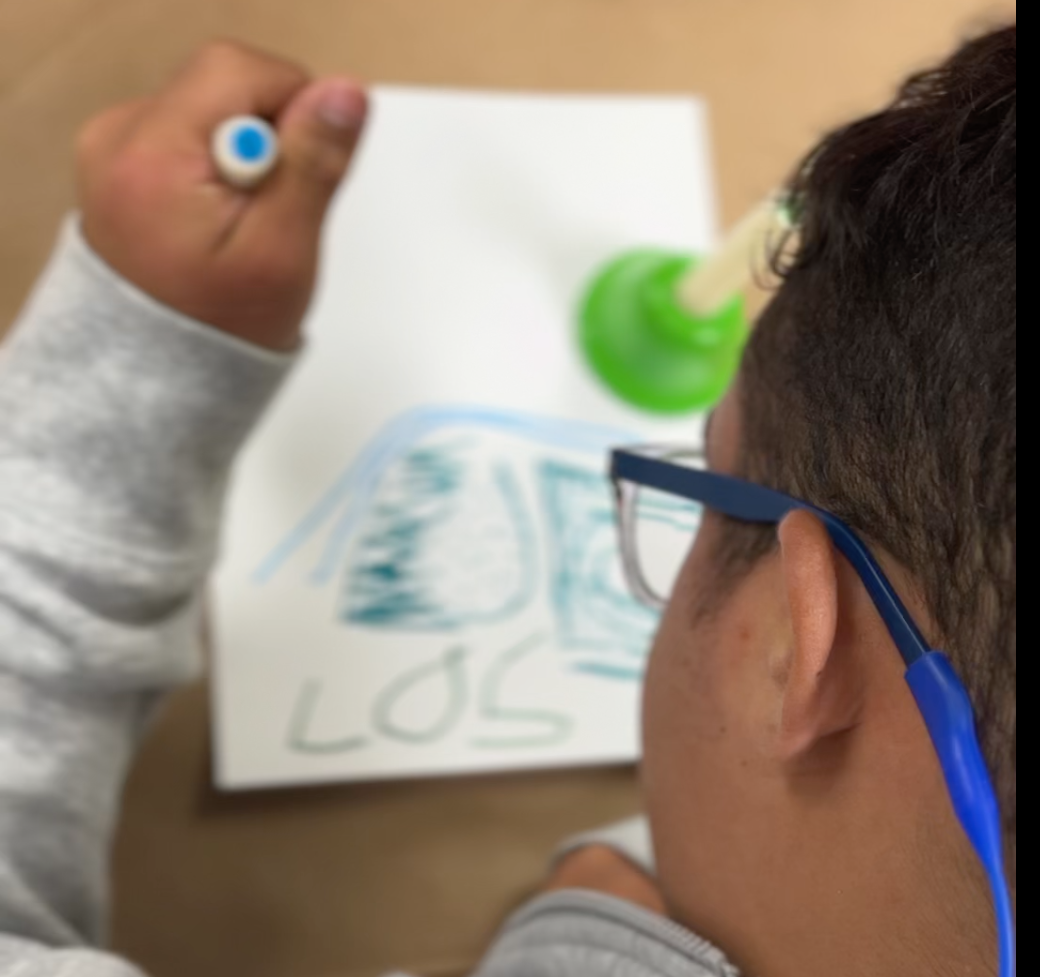
On the first day I opened with a question: we are in a museum, what do we have here? Everybody said: pictures. What kinds of pictures? They named paintings of dogs, cats, landscapes, boats, the sun. I said: but don’t we have something called a portrait — retrato — where the painting is like a photograph of a person? Yes, they said. So: let’s start today by drawing our portrait. As with past projects the drawings were immediate and revealing. If a participant wears glasses, the drawing has glasses. If they were wearing a jacket of a certain colour, the drawing has those colours. They always give context — no one placed themselves in blank white space; they always situated themselves somewhere. Antonio did his portrait and surrounded it entirely with stars of different colours, populating the whole space around him. We take that as their voices, given in a different way that day. One participant did not draw himself at all. He drew Kung Fu Panda. This happened also at Instituto, where a participant drew ‘Bad Bunny’ instead of himself. In both cases, when asked about themselves, what we received was not a self-image but an image of love — the thing most theirs. Theoretically, this is body image mediated through identification with an external object rather than direct self-perception — which is still a form of body image, just one that travels outward. We are not after the definitive answer to these voices. We know that they have shared aspects of themselves with us.
The act of drawing itself is worth examining kinesiologically and neurologically, because this is the curriculum that sits beneath the creative task. Picking up a pencil or crayon and making a mark involves fine motor grip, eye-to-hand coordination, and the activation of the kinetic chain from the fingers through the wrist, forearm and shoulder. For participants with varied motor profiles, the choice of instrument matters: a thick crayon or chalk block distributes the grip demand differently from a thin pencil, recruiting the palmar grasp rather than the pincer grip and reducing the precision demand on the distal finger joints. But the neurological dimension goes further. The body schema / body image framework (Vallar, 2025; Mourad et al., 2026) suggests that drawing oneself is not simply a motor task but a perceptual one — it asks the participant to construct and externalise a conscious representation of their own body as an object. That is a specific cognitive demand, distinct from the sensorimotor body schema that supports movement. This is why the drawing task and the movement warm-up are not separate activities: they are two routes into the same question.
To close Day 1, each participant shared their portrait with the group. The sharing was structured as a verbal description task — participants were invited to tell the group what they had drawn, whatever form that took, however long it required. This is language practice embedded in a creative act: the drawing becomes the prompt, and the speaking arises from the making. We applauded and celebrated every portrait, including those that looked — not Picasso, Joan Miró — which I know for those participants is exactly them.
Days 2 and 3, Tuesday May 19 and Wednesday May 20
Within the warm-up we are also building a movement phrase — a chain choreography where each participant contributes one gesture drawn from their favourite place in the garden walk. We have a phrase of four or five movements, still in progress.
It rained on Day 2 and we moved inside earlier than planned. We were able to complete the garden on the walk , which always serves as the nature observation moment for exactly this contingency. After the snack break, I put to them the question towatds the second drawing task. What else is in the museum? Paintings of landscapes. The task was a landscape painting of each participant’s favourite part of the garden. WE begam to experience the benefits of the project that can evolve daily, to see the benefits of continuity — participants were drawing on what they had spoken about, the gestures they had contributed to the choreography, the memory of the walk. The facilitators work as memory guides and imagination guides, helping participants return to what they saw and felt in the garden in order to bring it to the page. The first part of Day 3 continued this task to ensure everyone had a landscape painting.
Then I brought out the bells.
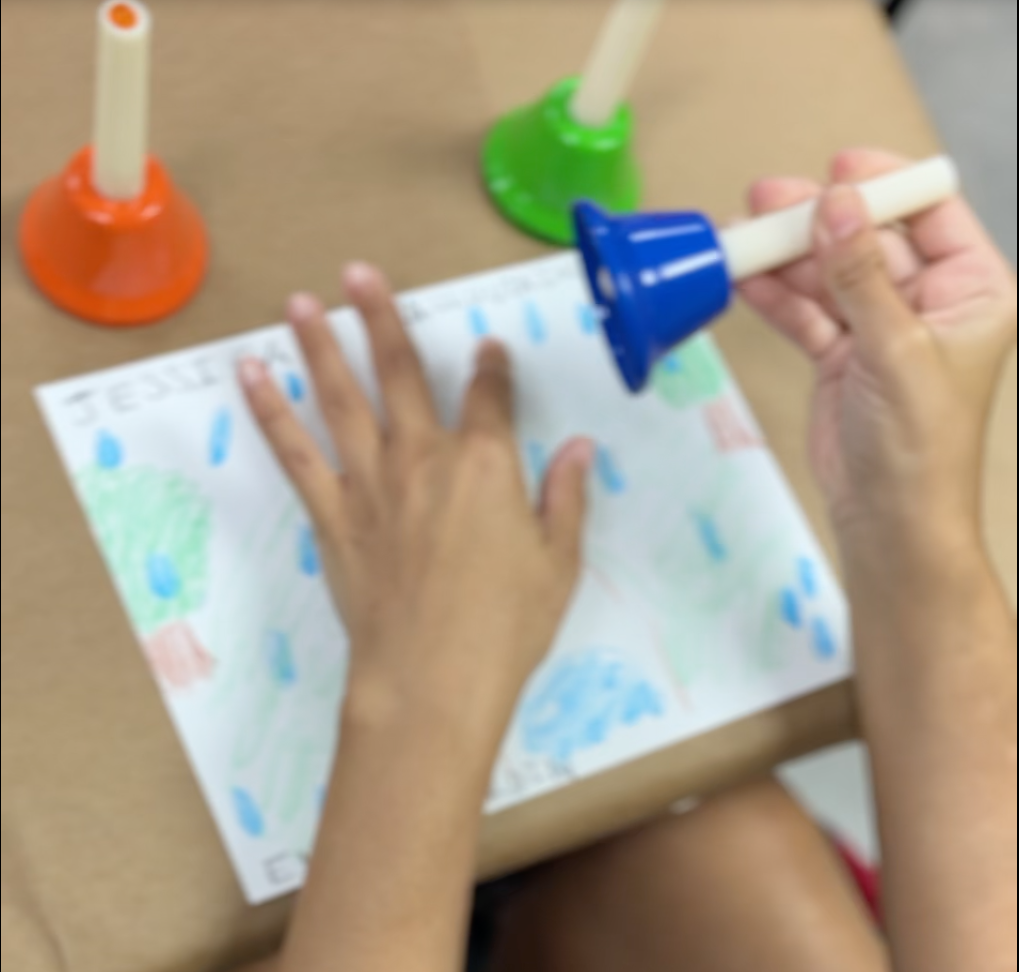
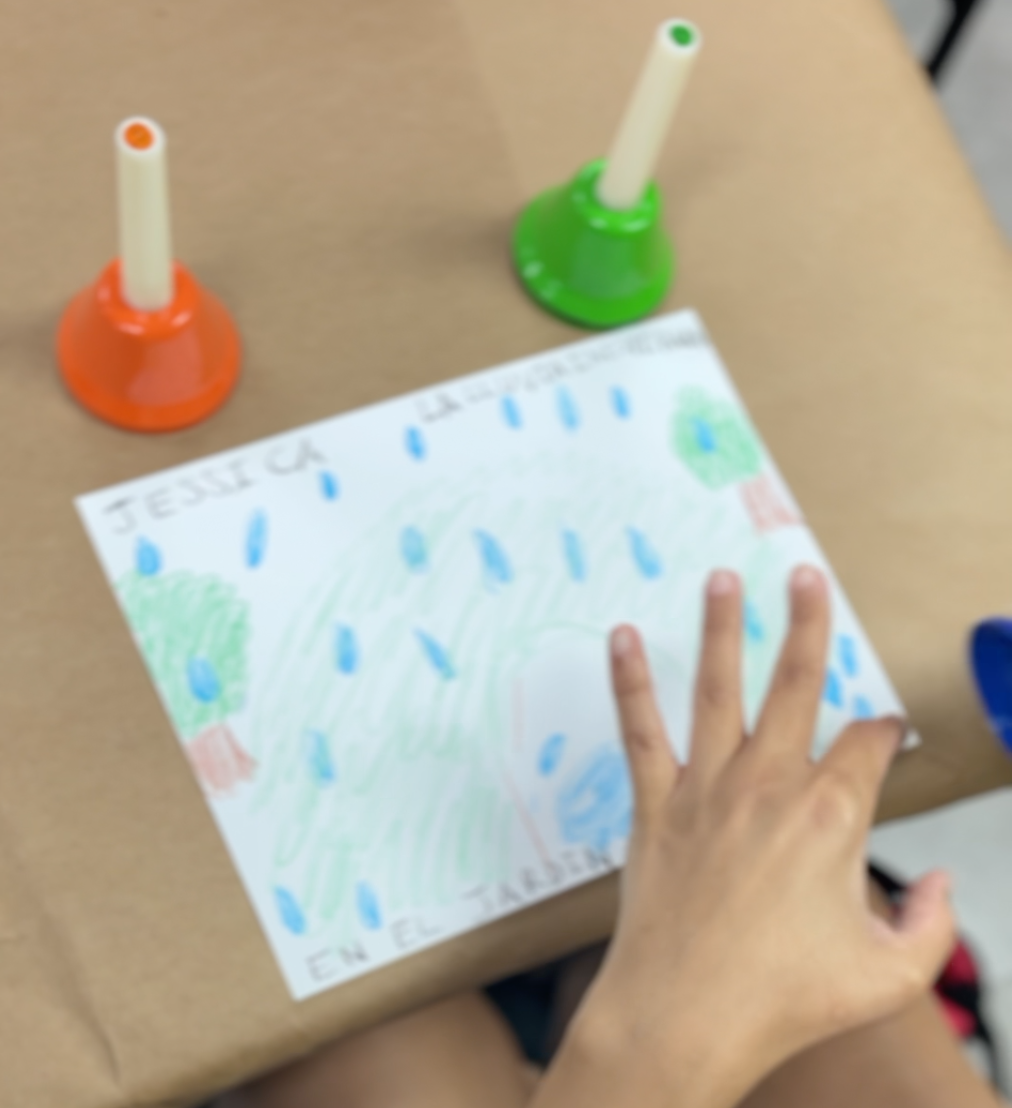
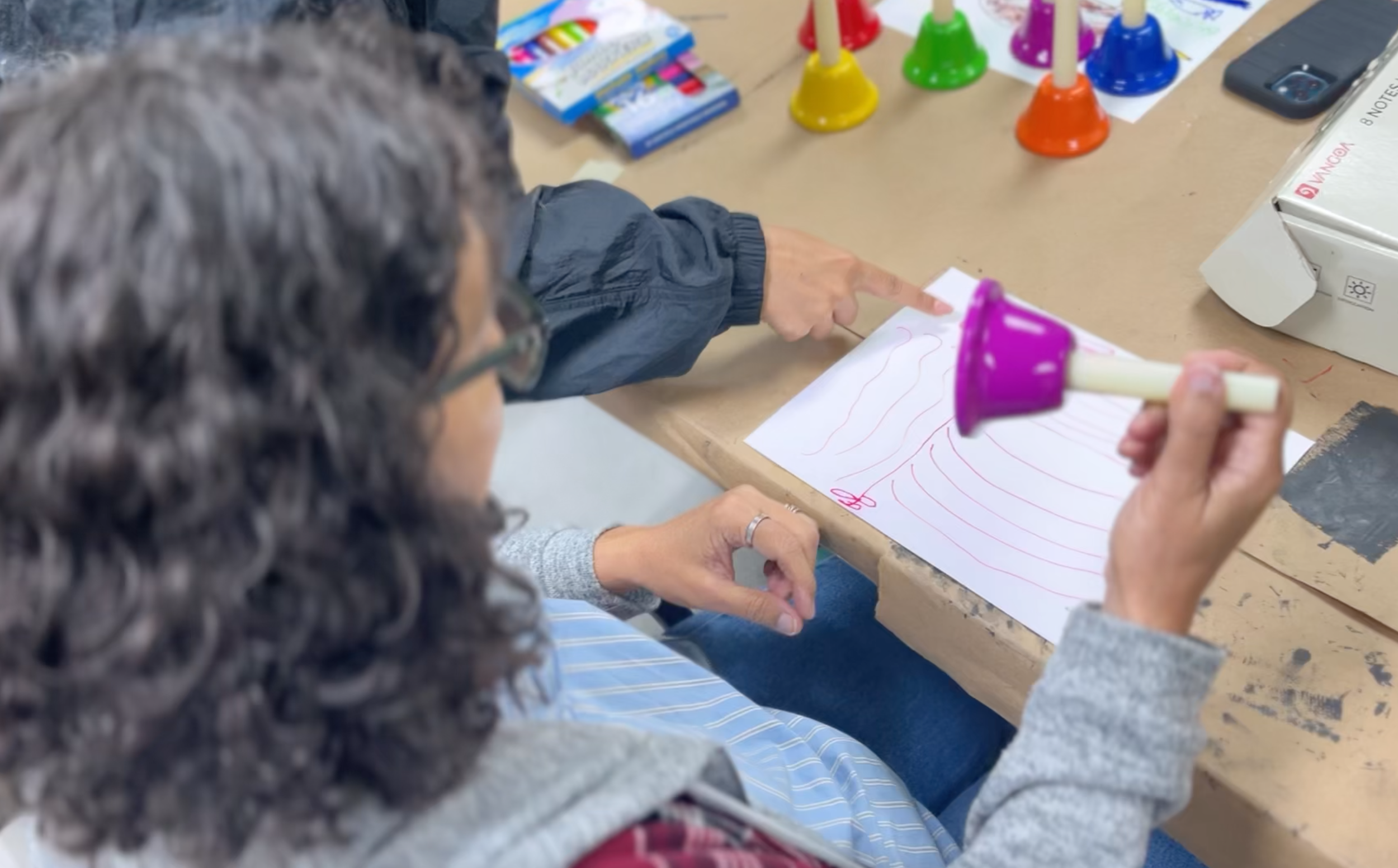
Vision.AI.R-E uses colour-coded handbells for creative composition — each colour corresponds to a pitch. On Day 3, the participants’ own landscape drawings became graphic scores: a ‘partitura’. Each participant ‘read’ the colours and marks on their page and responded with the corresponding bell. This is in the tradition of experimental graphic notation — Cornelius Cardew (1971) argued that the graphic score severs the requirement for musical literacy from the act of performance: the performer does not need to read, they need to decide. But the partitura task goes further than Cardew, because here the participant made the score themselves, from their own walk, and is now playing it back. And the reason the colour-to-pitch correspondence works without instruction is that it is not a convention to be learned — cognitive science has established that colour-intensity and pitch-brightness correspondences are perceptual capacities present in human beings from infancy, across modalities, before any musical training (Marks, 1978; Spence, 2011). The task recruits something the participants already have.
The results were extraordinary. Participants were not making random noise. You could see them looking at their drawing: if there was a red flower, they chose the red bell and rang it for as long as they were attending to that flower. Some gave musical form to the mark — ringing the bell four times because the flower had four petals. Those were compositional decisions.
Participants who had worked with me in the autumn 2025 sessions already knew the idea of a graphic score — then we had done it with colour circles cut from paper rather than their own drawings. Almost five months later, they brought that knowledge directly to the reading of their garden drawing. Jessica is the clearest example: she made a beautiful graphic score in November and December and brought that memory back to her partiture on Day 3. There is a video of that reading which I will put on the blog. This is the argument for sustained, cumulative programming with this population: the second experience builds on the first, and what accumulates is real skill.
Day 4, Thursday May 22 — The Collective Map
Day 4 was sunny, we did our morning physical practice in the garden.
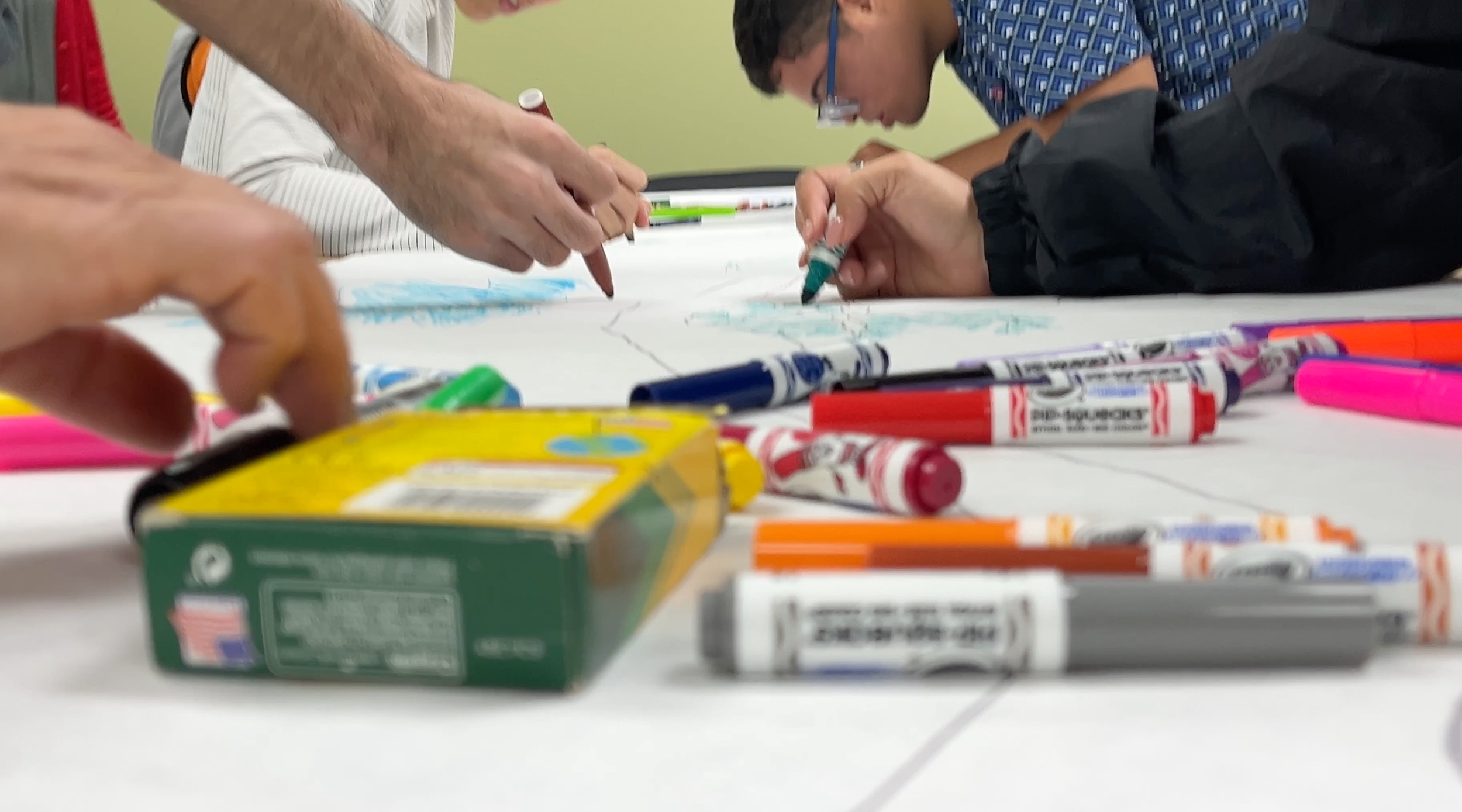
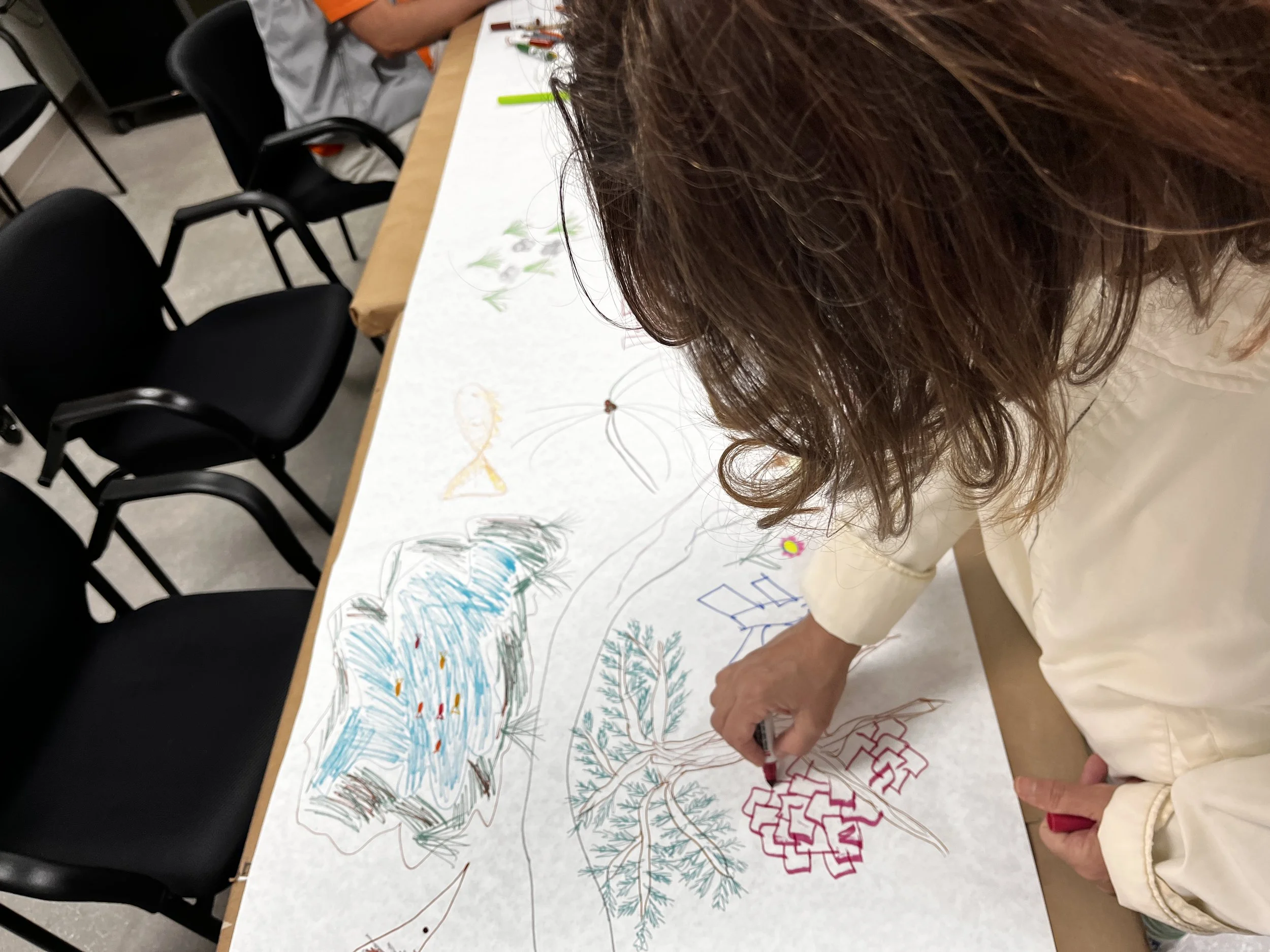
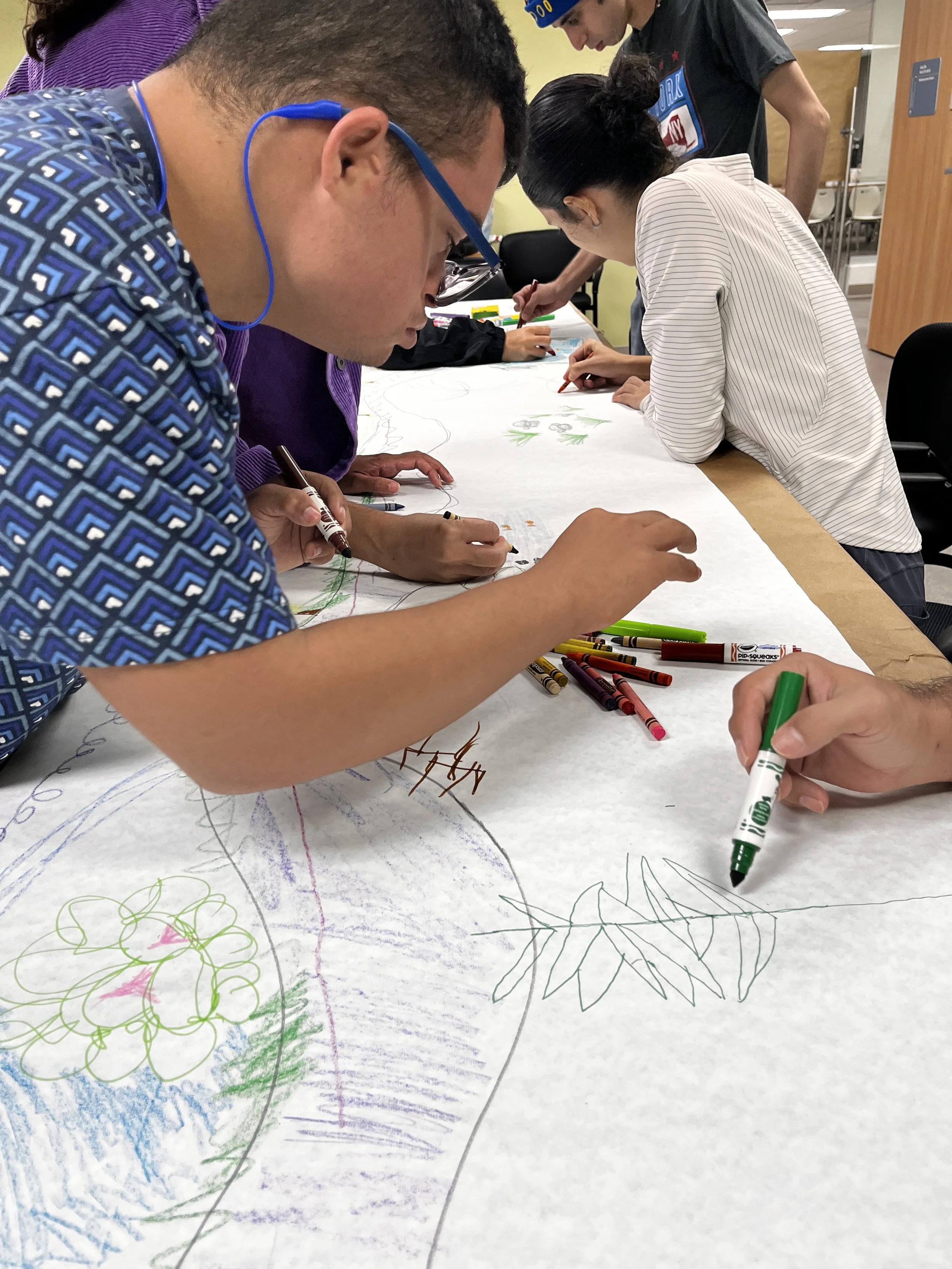
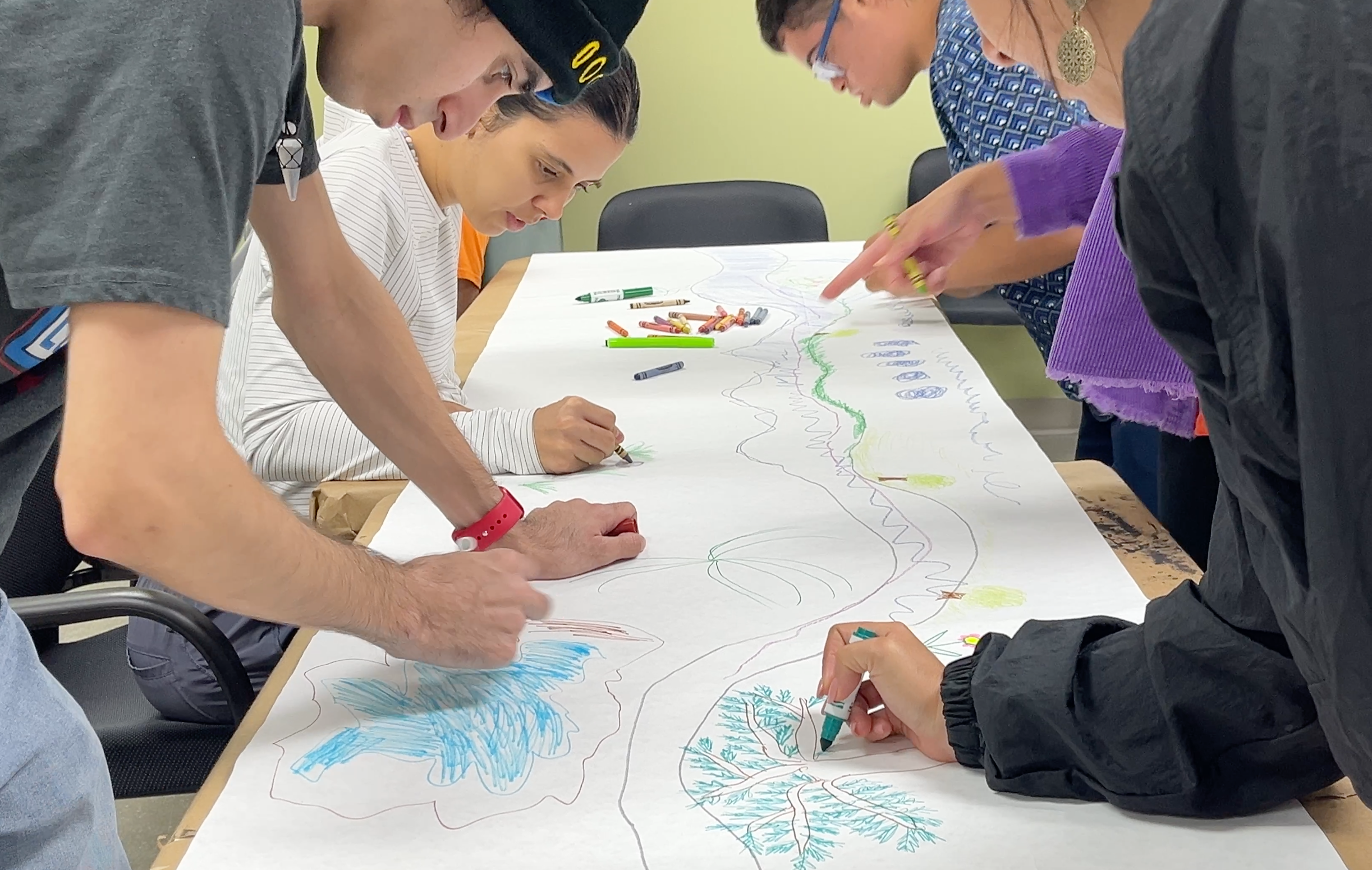
In the afternoon I laid out a long roll of paper the length of the table, the plan was to make a common garden path landscape drawing!. Matilsha, the director of Proyecto Opciones and a member of our team, drew the road. Then we collectively created the map of our walk. Some participants brought elements from their individual landscape drawings into the shared map. We drew the museum entrance and exit. Each person chose their section of the paper. The result was a long collective graphic score of the museum walk.
We spoke about what each person had contributed. Then: one by one, each participant walked the length of the table and performed an individual sound composition of the whole journey. Three boxes of bells on the table, every colour, triple and quadruple sets.
The task now had duration, space and intention — three of the foundations of the methodology. Participants had to move from one end of the table to the other, reading what was near and what was far, deciding where to slow down and where to move through quickly. You could see the shift: from those who were playing sound and colour somewhat freely, to those who were giving it musical form. The concentration grew as the duration across the table unfolded. Some participants could already be seen looking ahead along the partiture, making plans before they arrived. That is pre-planning. That is executive function. In a drawing task, with bells, in the garden of a museum. Day 4 was the beginning of a sense of consolidation — the multi-sensorial connections building their physical, kinesiological, perceptual and creative dimensions together.
Day 5, Friday May 23 — The iPads
Day 5 Rain moved everything inside. No garden on Day 5, but we held the space and did a strong warm-up, one-to-one with each participant.
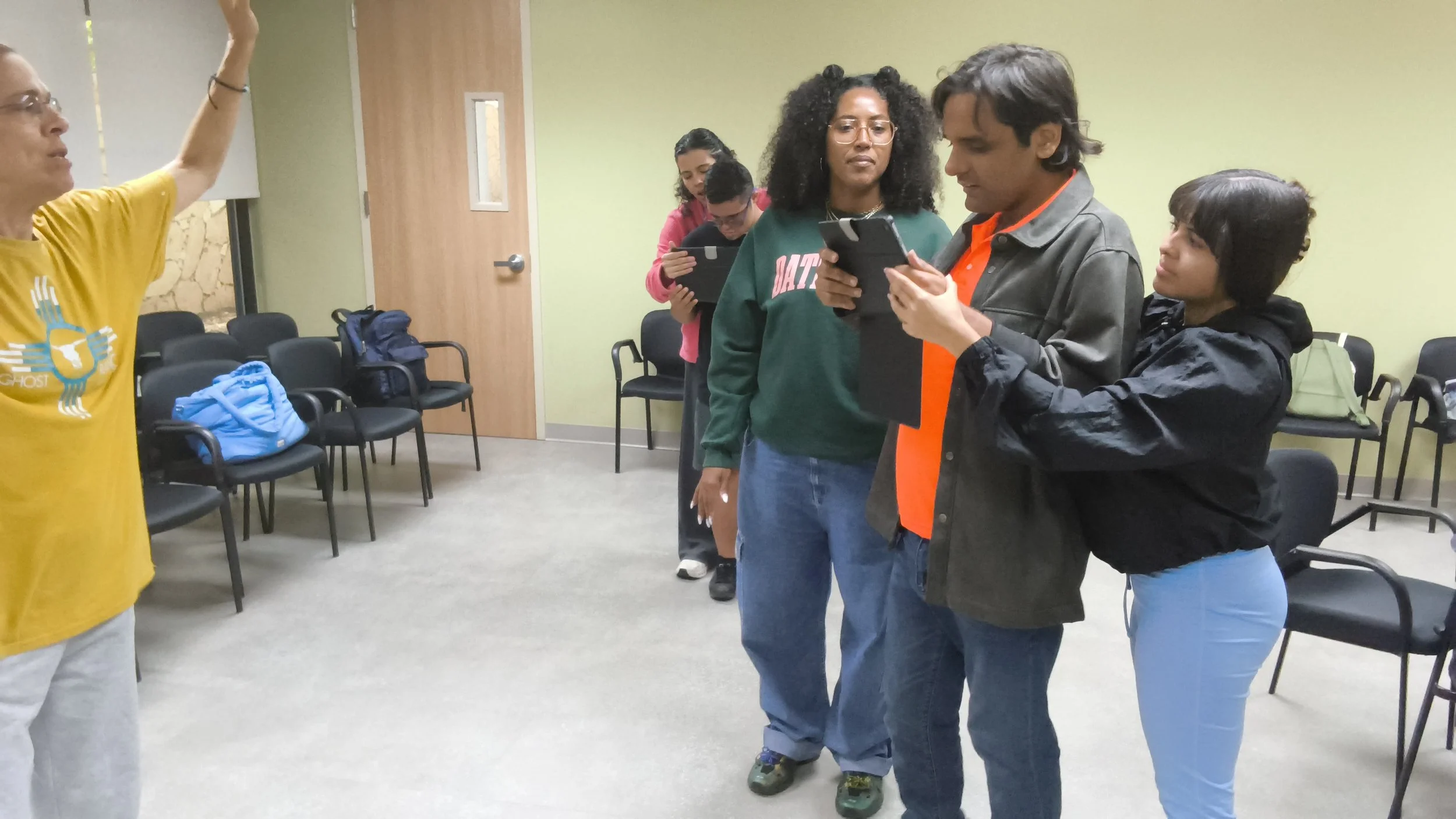
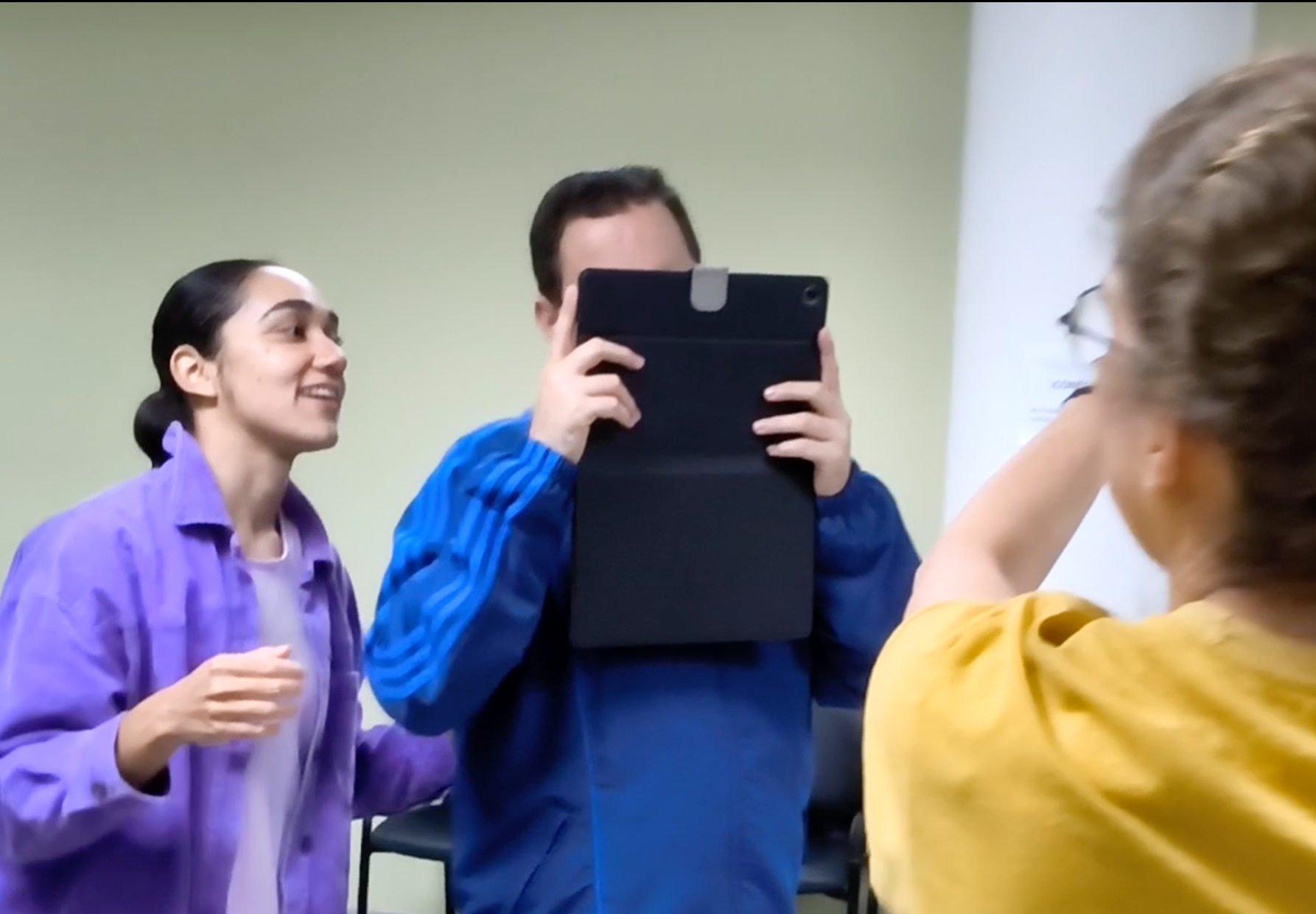
After lunch I brought out the Notebooks. Three years of work with this population has produced consistent evidence: Notebooks work for this group in ways that phones do not. The screen size, the sensitivity of the touch interface, the camera — all are better calibrated to what these participants need. One participant, who has low visibility and typically holds his phone inches from his face, experienced something different as he was able to put distance between himself and the screen. He could bring his existing technology skills to bear without the physical strain. His experience here is worth noting carefully: by having that distance he was restructuring what neuroscience calls peripersonal space — the body’s map of what is reachable and frameable around it (Maravita & Iriki, 2004). That is not a small thing.
The first task was portraits — the same task as Day 1, now with the camera. We tested whether participants could hold the device steady and whether they understood zooming in and out. Some zoomed by touching the screen; others understood it by walking toward or away from the subject. That zoom-by-walking approach was established in the methodology at Instituto last year and returned immediately here.
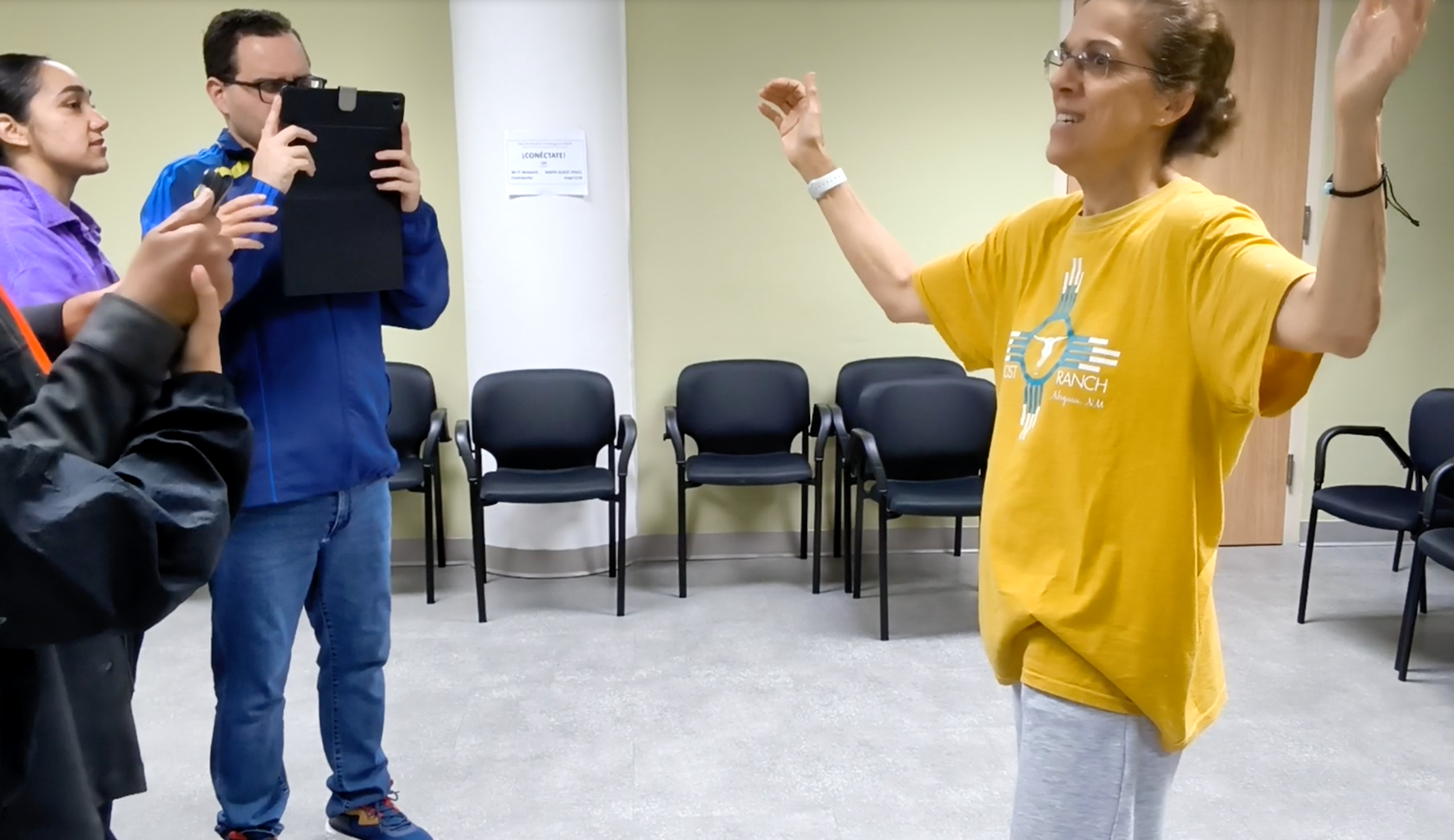
Then I began moving and we shifted into video recording — following a moving subject with the camera. Portrait, mid-shot, long-shot, tracking. In that simple open structure we were working on framing. The level of control was good. We moved beautifully into video recording.
Final Thoughts — Week 1 and What is Already Happening
What has become clear across this week is that the morning and the afternoon are doingcomplimentary ‘scaffolded’ work. The stick, the mirror, the bells, the drawing, the camera, and soon the AR world are all instances of the same operation: participant makes a mark or a move, that mark is trsnsformed across modalities through a perceptual correspondence that does not require instruction, and something is returned to them that is recognisably theirs. The tool becomes part of the body. The colour becomes a sound. The drawing becomes a world. This is the methodological thread, and it runs from the first warm-up to the final AR experience.
I began the first ARXperience renderings this weekend, taking the drawings from the sessions and building them as augmented reality worlds. Their marks become three-dimensional spatial environments. We have added what I call activation laws — elements that always appear in the world to invite movement: butterflies that draw the participant toward the edges of the space, prompting them to walk and turn through 360 degrees; flowers that appear and disappear, inviting counting. The butterflies and flowers are laws. The fish are present. All these elements exist in the museum garden. By Week 3, participants will step inside their own world through the Quest 3 headset, or watch it projected on a screen. The drawings they made this week are already becoming something else.
Week 2 begins Tuesday. Monday is Memorial Day.